Blog
News
The Internet Is Shifting From Search Results to Answers
Search engines once helped us find pages. Increasingly, they read those pages and construct the answer for us.

David Mitchell
Engineering
For most of the internet’s history, searching followed a familiar pattern.
You entered a few words, received a page of links, and decided which website deserved your attention. Search engines acted like maps: they pointed toward possible destinations, but the journey still belonged to you.
That experience is beginning to change.
AI-powered search can now compare sources, summarize information, answer follow-up questions, and help users complete increasingly complex tasks. The search box is becoming less like an index and more like a conversation.
That may be convenient for users, but it also represents one of the biggest changes to the open web in decades.
From Finding Information to Receiving It
Traditional search was built around retrieval. Its primary job was to identify pages that might contain the answer.
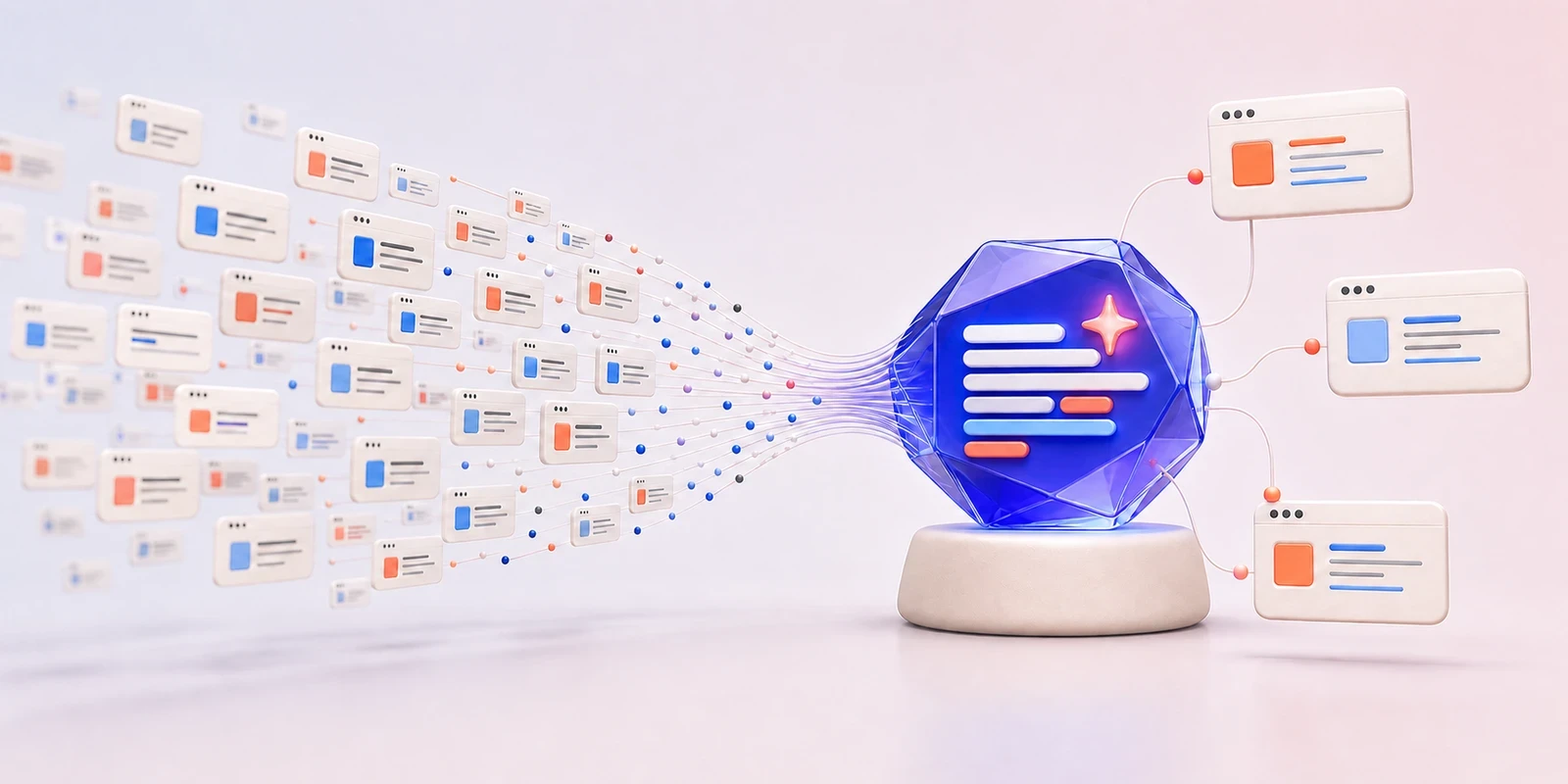
Answer-oriented search adds another layer. It reads information across multiple sources, identifies patterns, and presents a synthesized response before the user visits a website.
Google’s AI Mode, for example, supports conversational follow-up questions and increasingly agent-like research capabilities. In May 2026, Google announced that its AI search systems could examine blogs, news sites, social posts, and real-time information while monitoring the web for changes related to a user’s question.
The user no longer has to translate every need into a perfect collection of keywords. They can describe the outcome they want.
Instead of searching for:
“quiet mechanical keyboard wireless Mac”
A person might ask:
“What is a quiet wireless mechanical keyboard that works well with a Mac, is comfortable for writing, and costs less than $150?”
The system can interpret the complete request rather than matching a short phrase.
A More Conversational Internet
This shift changes the rhythm of online discovery.
People can begin with an incomplete idea, refine it through follow-up questions, and explore related concepts without restarting the search. Images, documents, live information, and previous questions can become part of the same conversation.
The benefits are easy to understand:
Complex questions become easier to express.
Information from several sources can be compared quickly.
Follow-up questions preserve the original context.
Research can begin without opening dozens of tabs.
Search becomes more accessible to people who do not know the right terminology.
But convenience introduces a new question: what happens to the websites that supplied the information?
The Website Still Matters
An AI-generated answer does not appear from nowhere. It depends on reporting, research, product documentation, firsthand experience, public data, and creative work published across the internet.
If users receive a complete answer without visiting the source, publishers may lose traffic, recognition, subscriptions, and advertising revenue. Smaller websites could find themselves contributing knowledge to the web while receiving less direct attention in return.
This makes source visibility increasingly important.
A healthy answer-oriented internet must help users understand:
Where information originated.
Which statements are supported by which sources.
Whether a source is current.
Where experts disagree.
How to continue exploring beyond the summary.
“When answers become the front door to the internet, sources must not become the back room.”
The goal should not be to preserve unnecessary clicks. It should be to preserve the connection between knowledge and the people who created it.
What This Means for Creators and Businesses
Ranking for a short keyword will no longer be the complete strategy.
Websites must become useful enough to quote, reference, compare, and recommend. Generic content that repeats what already exists will have less value when an AI system can summarize the same information instantly.
The strongest content will offer something original:
Firsthand testing and experience.
Clear explanations from knowledgeable people.
Unique research or proprietary data.
Strong opinions supported by evidence.
Tools, calculators, and interactive resources.
Transparent authorship and publication dates.
Specific examples that cannot be found everywhere else.
This is good pressure in some respects. It encourages websites to provide genuine information instead of producing pages designed primarily to attract search traffic.
Discovery Is Becoming a Conversation
The traditional list of links is not disappearing overnight. Some questions are still best answered by visiting a primary source, comparing products visually, reading a complete argument, or exploring a community discussion.
However, the starting point is changing.
Search increasingly interprets intent, assembles context, and helps the user decide what to do next. The internet is moving from a directory of destinations toward an active layer that sits between people and information.
The challenge will be preserving curiosity.
A synthesized answer may be efficient, but the web is valuable partly because it allows people to encounter unfamiliar perspectives, follow unexpected links, and discover ideas they did not originally know how to request.
Conclusion
The future of search will not be defined solely by whether AI can produce a good answer. It will be defined by whether that answer helps sustain the wider ecosystem from which knowledge comes.
For users, the change promises fewer dead ends and more natural exploration.
For publishers, it raises the standard for content worth discovering.
For the internet, it creates an important responsibility: make answers more useful without making their sources invisible.
The search result was once the beginning of the journey. The answer may soon become the beginning—but it should never have to be the end.
Further reading
Google describes the continued evolution of conversational AI Overviews and AI Mode in its January 2026 Search update, followed by new agent-like Search capabilities announced at Google I/O 2026.
David Mitchell
Engineering
Share

